Friday, December 3, 2021

EAP Supervisor Referral Tips from the Field: Educating Supervisors to Make Use of the EAP

Perhaps you have noticed. Managed care EAPs are nearly devoid of supervisor referrals, supervisor training, integration in progressive disciplinary processes, and absent supervisor consults on managing troubled employees.

So where are you getting tips to help supervisors refer. Here are a few I have assembled that you may wish to incorporate in supervisor training.

1. If your employee complains that a personal problem is affecting his or her life, and you suggest taking advantage of the EAP, this does not count as a supervisor referral if subsequent job performance problems emerge resulting from the same personal problem growing worse. Making a supervisor means meeting with your employee formally and saying you are making a supervisor referral based on unsatisfactory job performance. 

2. If you only verbally provide a list of your employee's performance issues, the EAP must repeat second-hand what you have said in the assessment with your employee. An argumentative employee will easily gain control of such an interview and make an assessment virtually impossible. A tangible list of issues is essential to keep the discussion on track. 

3. Only limited information is needed by supervisors to manage employees. The details of a personal problem are usually irrelevant to supervision unless disclosed to the supervisor for good reason with the employee's permission, often part of a need to be reasonable accommodated for some health condition.

4. Employee assistance programs are a benefit to employees, but they are also management tools to help preserve human resources. The failure of supervisors to view EAPs as management tools rather than just counseling programs contributes to their underutilization when performance problems are still small and manageable. When supervisors understand that the EAP is a resource for them as well as employees, they use it earlier to resolve performance problems that could lead to larger problems. 

5. EAPs are voluntary for employee use. But supervisors may be mandated to make a supervisor referral based upon violations of organizational policies by the employee. Alcohol and drug use is the most common example. Mandatory referrals (if they are part of an EAP policy) dictate the circumstances under which a supervisor must make a supervisor referral. These referrals are a form of intervention that give an employee a “firm choice” to accept the referral without delay or the consequences of the rule or behavioral infraction. This type of referral is actually attempt to accommodate the employee's possible personal problem, but the employee has to make the decision what to do. 

6. Mandatory referrals are often controversial, but don't have to be. They work effectively when incorporated into EAP policy as a procedural step following a serious work rule infraction. Employees who come to the EAP reporting, "I had to come, I had no choice. It was mandatory.", don't understand they have made a choice to accept help in lieu of termination or other disciplinary action held in abeyance to accommodate them. 

7. If your employee complains that a personal problem is affecting his or her life, and you suggest taking advantage of the EAP, this does not count as a supervisor referral if subsequent job performance problems emerge resulting from the same personal problem growing worse.  Making a supervisor means meeting with your employee formally and saying you are making a supervisor referral based on unsatisfactory job performance. 

8. Supervisor should never seek or attempt to get the EAP's "okay" for disciplinary actions or advice on the psychological impact of a disciplinary action, thinking the EAP knows the mental state of your employee better than you do. Similarly,  the EAP can't help select the disciplinary action that will work best for the employee. These types of EAP involvement will destroy program credibility.

9.  An employee who is terminated may not have much incentive to visit the EAP, but mentioning the availability of the EAP is still a good idea because the employee has a source of support at a stressful time.  If employees can use the EAP after termination, it is better than having no support at all. 

10. If you know your employee well, it is still not possible to predict whether or not he or she will accept a supervisor referral to the EAP.  Don't try to guess. Refer your employee to the EAP without making judgments about willingness to go. 

11. An employee confronted by performance documentation that he or she has never heard of or seen will feel angry. The natural response by the employee is to feel empowered minimizing or dismissing other documented performance problems. This makes the EAP assessment more difficult and cumbersome.  Give all the information to your employee so there are no surprises in the EAP interview. 

12. Supervisor referrals based on job performance problems—conduct, attitude, availability, attendance, etc.—will result in more employees with untreated behavioral-medical problems being seen by the EAP. And when personal problems are the focus, fewer employees are seen at the EAP.  Thinking of the EAP as way to help an employee improve performance will generate more referrals of employees with personal problems the symptoms of which you are unable to identify. 

13. Discussing the employee's personal problems jeopardizes your ability to manage performance because it leads to postponement of disciplinary actions and increases the likelihood of manipulation by the employee.  Your employee has superior ability to discuss his or her personal problems, and may willingly participate in a discussion to gain control in a disciplinary meeting or constructive confrontation concerning performance matters. 

15. Follow-up to discuss performance issues indirectly helps your employee remain focused on self-care and resolving personal problems so that acceptable performance levels are maintained. Follow-up reduces complacency, a major cause of relapse for many types of personal problems.  Follow-up has the powerful effect of helping employees stay involved in counseling, treatment, or care plans that could easily be ignored because of complacency

16. The return of performance problems on the job may be unknown to the EAP. You help the EAP when you report performance problems, and your report can be useful in further evaluating and confronting the employee.  Letting the EAP know what's going on in the workplace will help everybody win. 

Friday, November 19, 2021

EAP Role in Helping Employees Manage the Stress of Holiday Expectations

Expectations are often cited by employees as a key source of stress during the holidays, but pressure to participate in activities and events is less of a problem for many people than the sheer pressure of how one is supposed to feel during this time of year.

It's not so much the expectations of activities that may affect employees, it's the stress of faking how one feels that is the kicker.

If an employee suffers from depression, or if this time of year includes struggles over


memories past, help workers focus on the here and now, and teach them a bit about avoiding the “future-focus” of what they imagine is coming down the road.

Ask employees if they can identify from past holiday seasons where their support network lies? These may be individuals or even events that provide comfort and reduce stress. Some family members are more supportive than others in our time of need. You may notice in your personal life that some family are far more empathic in their communication and masters at saying the right thing. Others families may be so self-absorbed that listening is more than they can stand.

Have employees during an EAP assessment consider a plan of action. Have this include when they will attempt to connect or share time with these special people.

Also have employees Include in their support plan a way to connect with your company’s employee assistance program again during the holiday season or a mental health professional.

Employees should be prompted with the statement that they may only need a session or two to feel energized and in more control of their emotional state.


There’s an adage among members of 12-step groups: “Bring the body, and the mind will follow.” It means that behaviors can sometimes influence feelings. So, if the opportunity to participate in a seasonal event appears, and your EAP client doesn't feel motivated to attend, consider whether participation might surprise him or her with an uplifting experience and a positive change in mood they might otherwise have missed.

This article is founded one from the December issue of Frontline Employee newsletter for EAPs and workplace wellness programs. You can download free information here and use the EAP newsletter to help your program for a few months free so you can see the impact.

For more resources of EAPs and human resource managers, visit http://workexcel.com

Monday, August 17, 2020

Download Free Items from HandoutsPlus.com for Helping Employers Deal Anxious Employees and Parents Concerned about Back to School Issues

FOR IMMEDIATE RELEASE


Dan Feerst - Publisher of Workplace Wellness Materials Releases Free Handouts to Human Resource Managers to Calm Employee Anxiety and Support Parents Worried about Back to School Issues of COVID-19


This information is meant to help employees who are parents better manage
 their anxiety, worry, and stress associated with managing their children
going back to school in light of the COVID-19 pandemic.


Mount Pleasant, South Carolina, August 12, 2020, The COVID-19 Pandemic has been the cause of a tremendous amount of anxiety. It can and does, hurt employee performance. Information leads to knowledge, and knowledge eases anxiety and the fear factor. Many employers have cut their Employee Assistance Programs (EAP’s) in favor of 800 hotlines, which are not as effective.


Dan Feerst, author and publisher of HandoutsPlus.com, realized that he is in a position to offer this free information better than others because he is in the business of providing a plethora of Workplace Wellness Materials. These free items were prepared originally for employee assistance programs nationwide, but he is concerned few workers would gain access to these materials. They are therefore letting any human resource manager, workforce management professional, or CEO download them free without cost or obligation.


Included in the free package is a PowerPoint on managing stress and anxiety associated with the Coronavirus. Designed for employees are: reproducible and editable handouts in PDF, MS Publisher, and MS Word, a Web video for employers based on the PowerPoint, and a  reproducible/editable handout to distribute to employees who are parents to help them cope with stress and anxiety related to their children going back to school. The anxiety level of parents sending their kids off to school is through the roof, these resource handouts should help lessen their fears.


Dan Feerst wants employees to know that they have the option of receiving other free human resource related workplace wellness tip sheets regularly distributed without cost or obligation. An MP4 video on helping employees face the unique challenges of working remotely is also available.


They offer professionally authored handouts and tip sheets on workplace wellness topics and supervisor skills, reducing risk, improving employee’s assistance program functioning, and helping employees be healthy, happy, and productive. The Frontline Employee Human resources newsletter has been very well received by employers.


About Dan Feerst, Publisher:


Dan Feerst is the most widely read author on employee assistance program (EAP) content for supervisors. He has authored over 3,900 EAP and related wellness articles for FrontLine Supervisor and FrontLine Employee. Monthly readership of FrontLine Newsletters totals over three million employees. Subscribers include the U.S Army, the U.S. Congress, Universities, Hospitals, School systems, and industries.


FrontLine Supervisor has published continuously since 1993. FrontLine Employee has published continuously since 2001. You can find these publications on their other Web site WorkplaceNewsletters.com. You can find 220 other workforce management, HR, and EAP

resources and products at WorkExcel.com.


To obtain the free information package visit www.handoutsplus.com and click on “Free Tip Sheet”.


Media Contact:


HandoutsPlus.com

Attn: Media Relations

3601 West Higgins Drive, Suite 200

Mount Pleasant, SC 29466

800-626-4327

publisher@workexcel.com


Thursday, June 18, 2020

Welcome to WorkExcel.com’s latest catalog!


Ready to improve the health, safety, and happiness of your employees?

Inside, you will find over 200 EAP, HR, and workplace wellness tools and services to help your workforce become healthier, happier, and more productive. This is the largest collection of EAP resources ever assembled. [ download full catalog -- takes a few seconds ]

New to WorkExcel.com?

In 1994, we started the Frontline Supervisor EAP newsletter (see page 61) to save lives and reduce risk with more formal supervisor referrals to EAPs. After incredible success, we launched several more newsletters, including FrontLine Employee, as well as PowerPoints, videos, DVDs, web courses, tip sheets, conversion services, EAP posters, and more.
Today, we’re renowned for customizable, reproducible, never-late solutions for EAPs and workplace wellness programs – all authored by genuine pros. We also distribute free materials throughout the year. Sign up now at WorkExcel.com. download full catalog -- takes a few seconds ]

Cutting-edge solutions for improved performance

WorkExcel.com creates industry-leading products that we 100% guarantee will make the impact you want – but that’s not all. We engage the HR-workforce management and the EAP community to help us identify cutting-edge solutions that will help you do your job better.

Ongoing support and collaboration

Our relationship with you doesn’t end after you make a purchase. We are committed to helping you discover how to best use what we offer. So, stay in touch. Let’s collaborate. Together, we can thrive.
download full catalog -- takes a few seconds ]

Authored by professionals

Our authors are just like you. They have years of hands-on experience and understand your unique challenges and pain points. As a result, our content is practical, realistic, and evidence-based. We also source ideas from our subscribers via our dedicated hotline. download full catalog -- takes a few seconds ]

Discounts abound

Get more for your money with our discount offers. When you purchase training products from WorkExcel.com, receive 50% off a second, lower-cost format. And, if you’re a newsletter subscriber, you can enjoy 10% off any purchase! See the back cover for more. download full catalog -- takes a few seconds ]

Customizable products

You can quickly and easily add your logo to, customize, and edit all WorkExcel.com products, including newsletters, training programs, tip sheets, and more. That way, you get exactly what you want and maintain full ownership of your digital assets. No licensing. No added fees. No limits on users. download full catalog -- takes a few seconds ]

Transform PowerPoints into web courses

Have you got a PowerPoint presentation sitting around gathering digital dust? Hand it over to us at ppt2web.net and transform it into an interactive web course with sound, test questions, handouts, and even a certificate of completion. Head to page 98 to learn more. download full catalog -- takes a few seconds ]

Try before you buy

Still on the fence about one of our products? Get in touch to preview any product before you purchase. That way, you can be confident in the quality and suitability of our offerings. No guesswork means no wasted money. download full catalog -- takes a few seconds ]

FREE downloads and more

We believe in delivering real value. Head to information about free downloads, resources, and specialized tools. Do this by completing the form on the home page of WorkExcel.com -- Join our mailing list to receive free products year-round direct to your inbox, including workplace wellness products. download full catalog -- takes a few seconds ]

Find out more

Visit our other website for more game-changing products: HandoutsPlus.com, ppt2web.net, FrontlineEmployee.com, and WorkplaceNewsletters.com. download full catalog -- takes a few seconds ]

Friday, September 13, 2019

Help Employees Not Go Overboard On Worrying about Stress

Email for a tip sheet on this content that you can distribute to employees at publisher@workexcel.com - or click here.

Enjoy the Stress--It's Not All Bad


Stress Isn't Always Bad for You -- Here's Why

Although stress is a normal part of everyday life, we typically think of it as a bad thing. The reality is that some stress challenges us to improve ourselves because it pushes us beyond what we think we can handle. Without stress, then, we don't grow or adapt to new challenges. Here's why we should welcome some stress into our lives, and some tips on telling the difference between healthy and unhealthy stress levels.

What Is Stress? 

Stress is a natural response to change. It's the mental and physical symptoms you experience when you're exposed to new challenges or when you feel under pressure. Stress causes symptoms such as:

Elevated heart rate
Muscle tension
Faster breathing
Trouble sleeping because of racing thoughts and heightened awareness
GI problems e.g. nausea and stomach upsets

When you experience stress, your body releases a wave of hormones through the bloodstream. These hormones, such as adrenaline and cortisol, help you react quickly to a challenging or threatening situation. This is otherwise known as the "fight-or-flight" response.

The body produces the same hormonal response whether you're running for your life or getting ready for a first date. In other words, stress is never going to be eradicated from modern life, but the good news is that some stress is actually healthy.

Yes, really. Not all stress deserves a bad reputation. Let's consider why. 

Some Stress Is a Good Thing

Not all stress is created equal. Luckily, the most common stress we face each day is acute stress, and it's the least worrying form of stress. In fact, acute stress can improve our performance, sharpen our minds, and help us retain new skills.

Acute Stress 

Acute stress is caused by a recent event or an accumulation of multiple tasks. For example, you might be stressed by:

Exams
An upcoming wedding
Arguing with a friend
Looming deadlines

This stress only lasts for a short time. Once the triggering event is over, the stress disappears.

Why is acute stress sometimes a good thing, then? It's simple. Stress pushes us into action. If we didn't stress out over exams, we wouldn't study. If we didn't fret over deadlines, we'd leave tasks unfinished. And, thanks to sharpened reactions, stress lets us overcome challenges and solve problems that we couldn't figure out before.

Stress can be a motivator. It's pretty uncomfortable, but it forces us to get results. Think of it like exercise. The more you train, the stronger you become. Acute stress has the same effect.

Good v Bad Stress 

So it's clear that some stress actually benefits us, but what about when stress is harmful? Chronic stress is when the body is constantly in fight-or-flight mode. When this is the case, the pressure wears you down eventually. Chronic stress can be caused by:

Working as a caregiver to a sick relative
A toxic workplace environment
Unhappy or dysfunctional family
Long-term health problems
Ongoing poverty or job loss

Chronic stress is dangerous. It causes long-term mental and physical symptoms, and it may lead to heart disease, obesity, or skin conditions.

Tips for Managing Stress

Since some stress is a normal part of our lives, we must learn to deal with it. You can:

See a stressful situation as a challenge, not an impossibility
Accept when you can't control a situation
Avoid harmful responses to stress such as alcoholism
Get help when stress becomes a problem
Develop your organizational skills to stay on top of tasks before they become too stressful

Remember, stress can mean you're pushing yourself outside your comfort zone. You don't improve yourself when you're comfortable. Stress, under the right conditions, can inspire and motivate you to achieve your full potential.

To get a Stress Management Training PowerPoint Show that is editable for live or "movie like" showing, go to WorkExcel.com shopping cart here.

Wednesday, December 12, 2018

EAPs Helping Customer Service Employees Deal with Angry and Hostile Interactions on the Job

Few events cause employees more distress and contribute to more fantasies about quitting
Customer arguing. EAP training can help employees
than frequently encountering irate customers in a job. 

Does the company EAP have a role in reaching out, helping these workers, and in effect, claiming the high ground associated with this area of behavioral risk and exposure that can affect a company's bottom line? 


I say yes. And it fits the EAP core technology perfectly.

Violence in the workplace, verbal assault, morale issues, turnover costs, team degradation, employee-victims blowing off work the next day and calling in sick (aka "taking mental health days"), physical illness, and lower productivity -- all of these metrics can be adversely affected by a poorly managed "customer aggression intervention education program" in the workplace.

Never heard of such a program? You have now. I think you should consider starting one.
This is fertile ground for EAP work. There is plenty of research on the impact of aggressive customers and the consequences of their behavior on employee wellness. But there are few programmatic intervention approaches run by those with behavioral health knowledge and experience.

Frankly, hopes of the employee self-referring to the EAP are not really going to cut it as the only way to deal with customer service stress. A more proactive approach is needed.

I am developing a tip sheet on this topic and will make it available to you soon, but at least for now, let's discuss some of the ways employees can cope with this common workplace issue of customer service stress vis-a-vis the angry customer, and bit about the EAP role.

Customers Can Turn on Employees

Customers can turn on employees, dehumanize them, and treat them with hostility because they represent the organization to which their fury is targeted. An employee representative is the company or business. Without customers seeing employees in this fashion, they can't act out successfully. This gives a strong clue to intervention - humanness. [Suggested EAP Resource for customer service 1 of 3 ]

A recent study released this past summer found that consumer bargain hunters, for example, treat store clerks "as less than human." It's almost as though they go into "a zone" that turns employees into objects. Here's the study.

You can assume there are customer service employees who, after dealing with an irate customers, desire nothing more than to drive home, jump back into bed and hide under the covers. These workers are your target audience for offering additional support from the EAP.

Add value to your EAP by developing referral funnels that spot these workers, discover their needs, and turn them into thankful clients. This is truly "value-added" EAP at its finest.


Help employees discover the tricks of the trade for dealing with angry customers. Here are a couple ways to counsel these employees so they develop more resilience and are able to help themselves face hostile customers.

Listen first, speak later

employee listening to customer with empathy to reduce stress
Help employees understand that the initial burst of anger from customers will almost always be the most intense. From there, things are going to go downhill (in a positive sense.)

This is a powerful awareness, and like the other tips that follow in this post, helping employees "reframe" their experience is critical in order to help workers feel more empowered.

Because it’s so stressful for the person on the receiving end of the hostility, many flustered employees mistakenly try to end confrontations a bit too quickly in order to ease their own discomfort associated with the behavior of the customer. This is a tactical mistake. But, of course it is understandable. [Suggested EAP Resource for customer service 2 of 3 ]

Ironically, quick intervention leads to escalation of the angry and hostile customer reactions. The missing link? It's empathy. Coaching employees to resist the urge interrupt, argue, or engage in problem solving immediately is key to helping reduce customer agitation.

Remember those counseling interview courses or social work interviewing courses you took in school? You undoubtedly learned about the levels of empathetic response that professional counselors use to help clients feel heard. This is an excellent model of communication that customer service employees can also learn. And you can teach it to them.

Learning the levels of empathetic response will be fun learning and it will also be appreciated as a way of helping employees remain calm and keep their cool when customer aggression ramps up and the pressure is on.

You want to help employees develop better reflexes and actually relax in the face of customer agitation. Teach them to slow down their breathing and listen intently without fear -- help employees become fearless customer service honey badgers as they maintain eye contact with their customers.

Apologize and Empathize

Employees should learn that the angry customer eventually runs out of steam and pauses to collect his or her thoughts. When this happens, you've got them -- right there, take the opportunity to apologize. This is the employee's  "in."

Apology is an art, and it is well worth learning. So, the EAP should do a couple presentations or role plays. Not difficult, but important.

Apologies can reduce the customer service employee's stress, as well as the customers'. Help employees learn the art of an effective apology because it goes right to the heart of what has upset the customer.

For example, a customer who is displeased about an undisclosed $10 service charge is more likely to be angry about feeling deceived than about the fee itself. Help employees understand that this is the crucial link to address. Addressing this anger specifically and empathizing with it will be powerful. [Suggested EAP Resource for customer service 3 of 3 ]

Remember above when I discussed the "levels of empathy" that you may have learned in professional counseling courses in college? Draw on this material. It is a good place to practice these skills. Here are the levels in response to the above. You may have to create your own examples, but follow this model below and you will do great.


Issue: "Customer is angry and shocked at a $10 service charge."

Empathy 1: "Don't blame me."

Empathy 2: "I can't do anything about it."
Empathy 3: "Sorry you are just finding out about this." 
Empathy 4: "Your reaction to this charge justified."
Empathy 5: "I must feel blindsided and taken advantage of by this."

As you can see, the above can create a lot of discussion in a seminar setting with customer service employees, but who better to help them deal with stress, understand empathy, gain resilience, have a bit of fun, and experiment with empathetic responses and customer than you as the EAP?

A mistake but often seen as an easy out for customer service employees that actually makes problems worse is resisting the anger and blame. Employees often attempt to shift or pass the buck to others in the organization so one does not feel targeted. In your customer’s eyes, you are the company, so don’t take anything that’s said to you personally. (Admittedly, this is easier said than accepted at an emotional level, but with practice and tools, it eventually becomes part of the employees "tool box."

Reflection and Clarifying

More customer service training for employees that you can consider is helping them understand is how to immediately, after apologizing, repeat the customer’s complaint to him or her.

This reflection and clarification assures the customer that the employee is concerned about the problem and will help the customer avoid further misunderstanding that may incite anger again. This is the part of the proof that things are going to get better.

Maintain a calm, positive tone
Employees have tremendous influence over their customer’s emotional state. This is the key point in any seminar to assist them in stress management. For example, something like lowering the voice and speaking slowly and calmly in a pleasant manner relaxes and disarms most angry customers.

Taking immediate action

The longer customers wait, the more they seethe. It is a simple strategy to make the unhappy customer the employee's top priority. This is in fact, the first rule to reduce one's personal stress. Avoid delay and denial. Help employees understand that the goal is ultimately to have the customer see the customer service employee as not just an employee, but an advocate. Without this goal in mind, the default position is "opponent." Once empathy is shown, a quick pivot to a discussion resolution the customer is looking for is the correct path.

When an employee can't find an immediate answer or solution, then what? The best answer is usually taking charge, promising to follow up later. Take down the customer's contact information and outline the corrective steps one is going to take. This part is critical in order be believed. The employee risks escalation without this "part B" to the follow up promise. Include the names of everyone who will be involved in the solution.

Example: “I’m going to send this purchase order to Sarah, our inventory manager. She’ll order the correct part for you. It should be here on Tuesday. She’ll call you at the number you provided”

“If you have any problems, please contact me immediately and I’ll help you resolve it. Here is my card.”

One of the biggest drivers of customer anger is feeling like they’re getting the runaround. Taking these steps assures your customer that:

  • She is valued.
  • You have a plan.
  • She won’t be abandoned.
  • You will be accountable and available for follow up.

Follow up


Don’t write them off! An angry customer is not necessarily a former customer.

A follow up phone call or message a few days following the resolution of a complaint sends the message that the customer service worker cares about delivering satisfaction. Most customers just want to feel valued. Small considerations build loyalty.

Employees who are customer service workers can’t please everyone, but they can improve and enhance company’s image and responsiveness in every dispute. The more they practice these above techniques, the more success they will have in calming customers and winning them over. And of course, less stress is the big payoff.

Tuesday, November 20, 2018

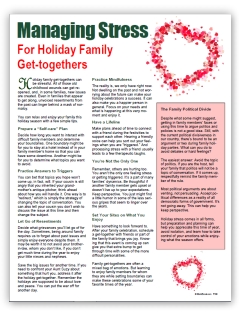
Download Reproducible Holiday Stress Tip Sheet

Download Reproducible Holiday Stress Tip Sheet: Free holiday stress tip sheet and reproducible handout for workplace wellness, free to distribute, editable, web usable.


Holiday stress and family conflicts are a common concern among employees. They can add to the difficulty of the season. We we decided to create this reproducible and editable tip sheet for workplace wellness.
Holiday Stress Free Tip Sheet to Reproduce and Distribute
We think it hits all the right spots, including thinking ahead and preparing a personal care plan; understanding and responding to triggers; letting go of resentments; practicing mindfulness; having a "go-to-friend" for support if needed; recognizing that no one is alone with this problem or issue; focusing on the fun and valuing loved ones. We also included a special section on the political divide we all only know too well!

Click here to download JUST THE PDF or go here to download 
the EDITABLE MODULE.

This workplace wellness tip sheet is yours to copy and distribute without attribution, but if you put it on a Web site, please place a "back-link" someplace on your Web site--even in the farthest corner--where it is viewable by search engines --  [ http://workexcel.com ]. This will cause search engines to rank us higher and it helps us create more free tip sheets for you!

Other key links to explore . . .

1. See the WorkExcel.com Online Catalog--flip the pages!

2. Download the PDF catalog - 25mb....so it takes 20 seconds

3. Shorty Catalog, like #2 above, but on two sheets

4. Download everything you ever wanted to know about our "flagship" product FrontLine Employee Editable Wellness Newsletter-- here.

Friday, November 9, 2018

Women in the Workplace 2018 PDF (Download)


There's a lot of critical information in this new report on women in the workplace.

Despite the push to grow more diverse and inclusive workplaces, African American women in top management are still quite rare.

And there are more findings in this report critical to workforce management.


The new 2018 Women in the Workplace Study is a document you should read for three important reasons:

1) awareness for the problem of barriers to gender diversity that still exist;
2) the reliability of the information found in the document that discusses many aspects of modern day institutional discrimination; and
3) ideas about how you can make a difference in your role no matter what it might be.
The study was conducted by the prestigious accounting firm of McKinsey and Company.


Women in the Workplace 2018 PDF (Download)

Thursday, November 8, 2018

Download a New Reproducible Wellness Tip Sheet

Download a New Reproducible Wellness Tip Sheet

Loneliness is become a national health problem, but if you are a professional counselor or EAP, you are on the front lines in making a impact on this killer health condition.

Thursday, November 1, 2018

Download a New EAP Workplace Wellness Resource and Health Tip Sheet: "Overcoming Loneliness"

Download, reproduce, and distribute this new workplace wellness tip sheet from
WorkExcel.com on "Overcoming Loneliness."

If you get FrontLine Employee, you saw the article on loneliness that we authored for the June 2018 issue. This tip sheet gives the rest of the story and offers more direction for employees.

You will make a big impact, help your program's visibility, increase referrals, and demonstrate value with WorkExcel.com resources --especially tip sheets and newsletters: Keep people thinking about what you offer with our help. We are now in our 25th year.

Follow this this link to learn more and download the tip sheet.

http://www.icontact-archive.com/YAuysBsJ0Zzmn9lCXd4C94pl0pSeJOPr?w=3

Friday, October 12, 2018

Try this Stress Management Training Technique: Forward Thinking to More Awesome Moments


Cold and rainy. Nope, doesn't get any worse. If only there was a way to change our attitude
stress management training in PowerPoint and other formats
in a second because coffee barely scratches the surface. A book should be written about stressmanagement techniques and tips for Monday mornings, but it doesn't exist yet, how about this idea.

Remember the relief and positive feelings you experienced during the week just before you went on your last vacation? No matter how stressful it was, you found an oasis in your mind when you thought about what was coming soon. Read more... 


Wednesday, October 10, 2018

​Effective Workplace Communication that Reduces Coworker Conflict: Stop Reading Minds and Start Checking In: - WorkExcel

​Effective Workplace Communication that Reduces Coworker Conflict: Stop Reading Minds and Start Checking In: - WorkExcel

Is your coworker driving you nuts? If so, you may be making it worse by suspecting ulterior motives and hidden meanings in what they do or say. Does this experience sound familiar? If it does, know that you’re not paranoid. This hyper-vigilance is explained by nothing more than stress and the “fight or flight” syndrome all of us experience when we feel threatened. Gaining control or at least having awareness over this phenomenon is in part, key to overcoming workplace conflicts. 
As natural as your response is to your work nemesis, hyper-vigilance can get out of control and create a lot of . . .
read more.